
















New minds, new markets
AI-powered consumers could drive up to 55% of spending by 2030—less than five years from now. Stay ahead of the curve by understanding these consumers, and how their wants, needs and expectations will shape tomorrow’s markets.
Discover industry-specific solutions and expertise.
Solve your toughest A&D challenges with Belcan.
Ignite peak performance and efficiency in your business.
Reimagine your manufacturing competitive advantage.
Accelerate growth with customer-focused solutions.
Deepen customer loyalty, drive long-term relationships and boost profitability.
Meet customer demands for a digital, personalized online insurance experience—while reducing risk.
Digitally transform to empower a more intelligent, agile and high-performing enterprise.
Helping US federal, state and local governments modernize technology, reimagine processes and transform experiences.
Deep industry expertise to propel your business into the future.
Turning Agentic AI into governed enterprise value
Modernization that secures and enables enterprise AI
Real-time AI governance, security and trust at scale
Scaling sovereign enterprise intelligence
Maintain high integrity across the AI lifecycle.
Transforming workforces at the speed of AI
AI-powered business operations automation
AI insights to inspire enterprise transformation.
Uncover the $6 trillion in trapped AI potential hidden in the workforce.
Turn AI spending into real productivity gains by investing in workforce skilling.
Discover how to become a high AI performer—and realize billions in AI returns.
Explore the latest in AI in our newsletter released bimonthly.
Explore how our expertise can help you sense opportunities sooner and outpace change.
AI-powered consumers could drive up to 55% of spending by 2030—less than five years from now. Stay ahead of the curve by understanding these consumers, and how their wants, needs and expectations will shape tomorrow’s markets.
Soon, business leaders will need to compete in a world where human consumers, along with their AI agent counterparts, dictate the rules of engagement. Our research reveals how AI will reshape the consumer journey and how businesses can navigate the transformation.
Our study, conducted in partnership with Oxford Economics, is based on a survey of over 8,400 consumers in four countries, supplemented with extensive economic modeling and in-depth discussions with 80 consumers.
To understand how AI will change consumer behaviors and quantify its long-term economic impact, we segmented consumers into demographic groups based on their likelihood to use AI. The analysis was based on insights from our survey and historic patterns of technology adoption.
Early Adopters and Accelerators are the most keen to embed AI into their purchasing journey, while Anchors remain skeptical.
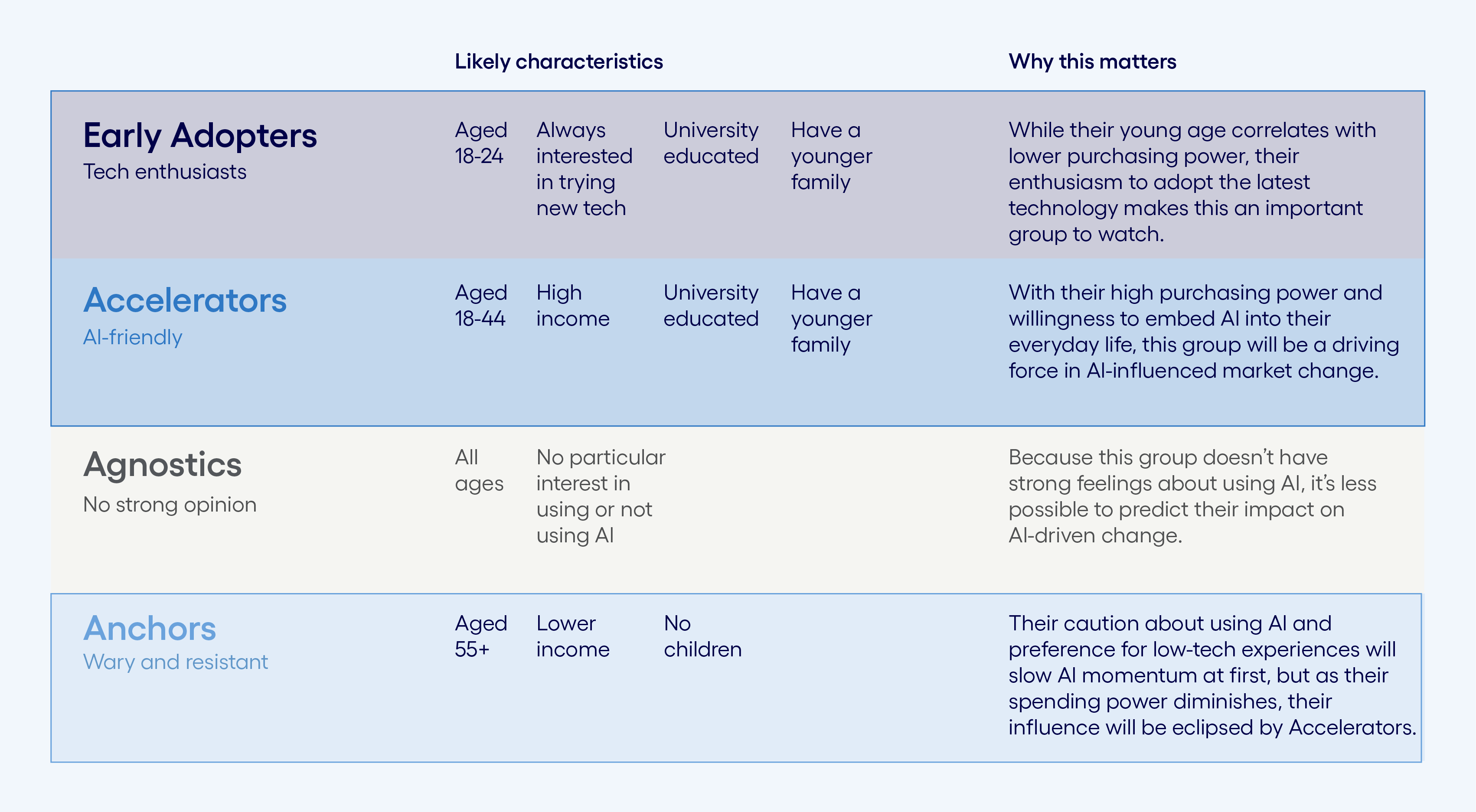
Figure 1
Our analysis uncovered demographic details that are statistically most likely to be associated with each of these groups. The characteristics are independent of each other, and do not necessarily apply to each consumer in the groups.
Base: 8,451 respondents in the US, UK, Germany and Australia
Source: Cognizant and Oxford Economics
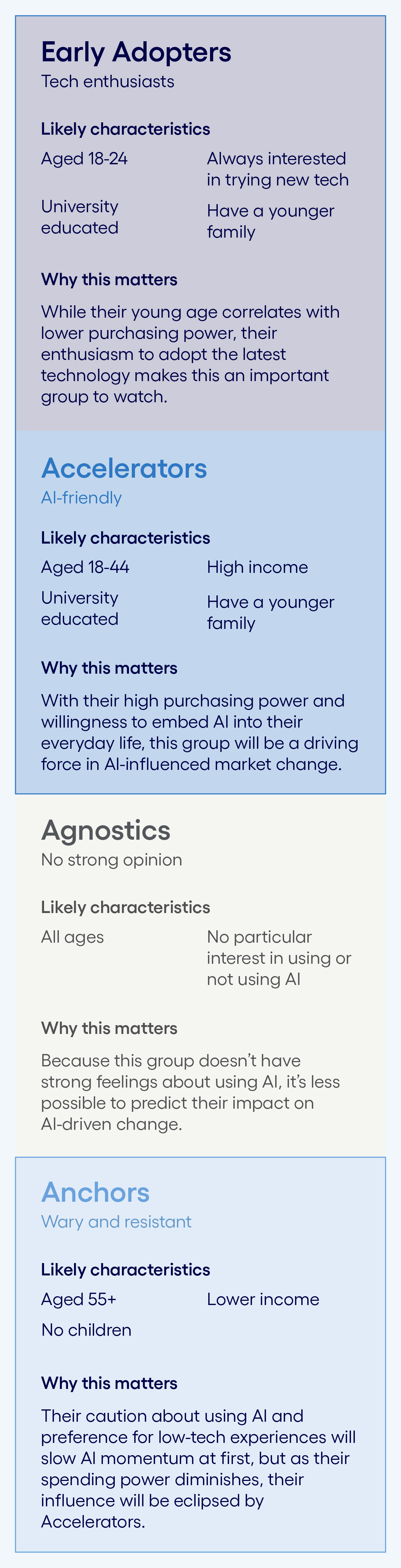
Figure 1
Our analysis uncovered demographic details that are statistically most likely to be associated with each of these groups. The characteristics are independent of each other, and do not necessarily apply to each consumer in the groups.
Base: 8,451 respondents in the US, UK, Germany and Australia
Source: Cognizant and Oxford Economics
To understand consumer behaviors at a more granular level, we also studied AI use at each phase of the customer journey: Learn, Buy and Use. Our Comfort Quotient reveals uneven receptiveness to using AI across the purchase journey.
A composite score of consumers' comfort with using an array of AI tools across the three stages of the purchase journey and 36 products and services in 15 industries, based on survey data and in-depth consumer interviews.
Higher number = more comfortable
Lower number = less comfortable

Consumers feel most comfortable with AI at the Learn phase, making it the first and most critical phase for businesses to focus on. Early Adopters and Accelerators have much higher scores of 58 and 50, respectively, while Anchors have a score of 33.

This decision-making phase is where we saw the most hesitation from consumers. Even Early Adopters and Accelerators have comparatively low scores of 34 and 33, respectively. Anchors are particularly hesitant, with a score of just 16.

Consumer comfort with AI rebounds in the post-sales engagement phase. This score is buoyed by Early Adopters and Accelerators, with scores of 47 and 37, respectively, but also by a strong showing from Anchors. With a score of 34, Use is where Anchors are most comfortable with AI.
Figure 2
Base: 8,451 respondents in the US, UK, Germany and Australia, as well as 80 in-depth consumer interviews
Source: Cognizant Research analysis of data collected by Oxford Economics and YouGov
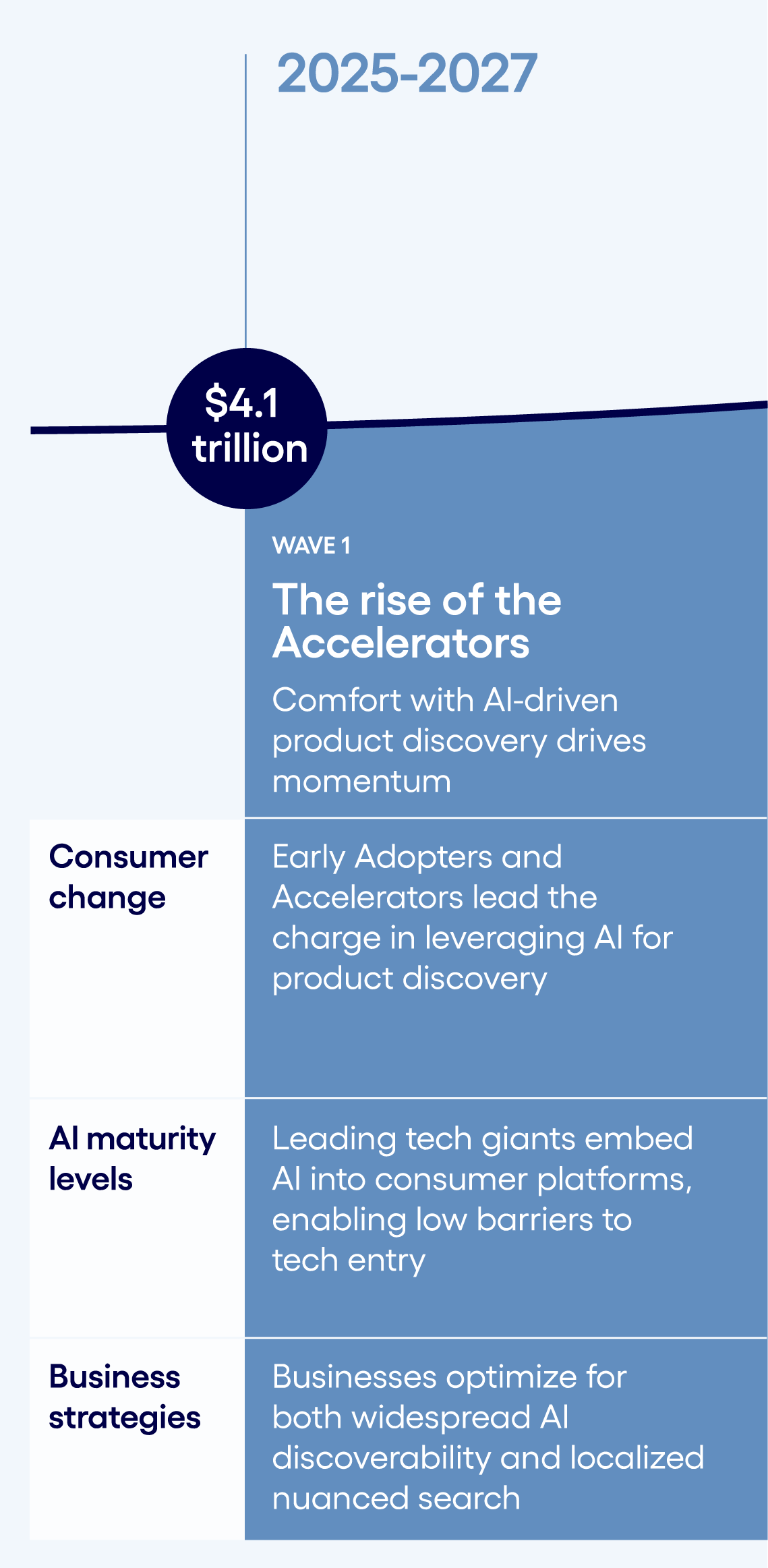
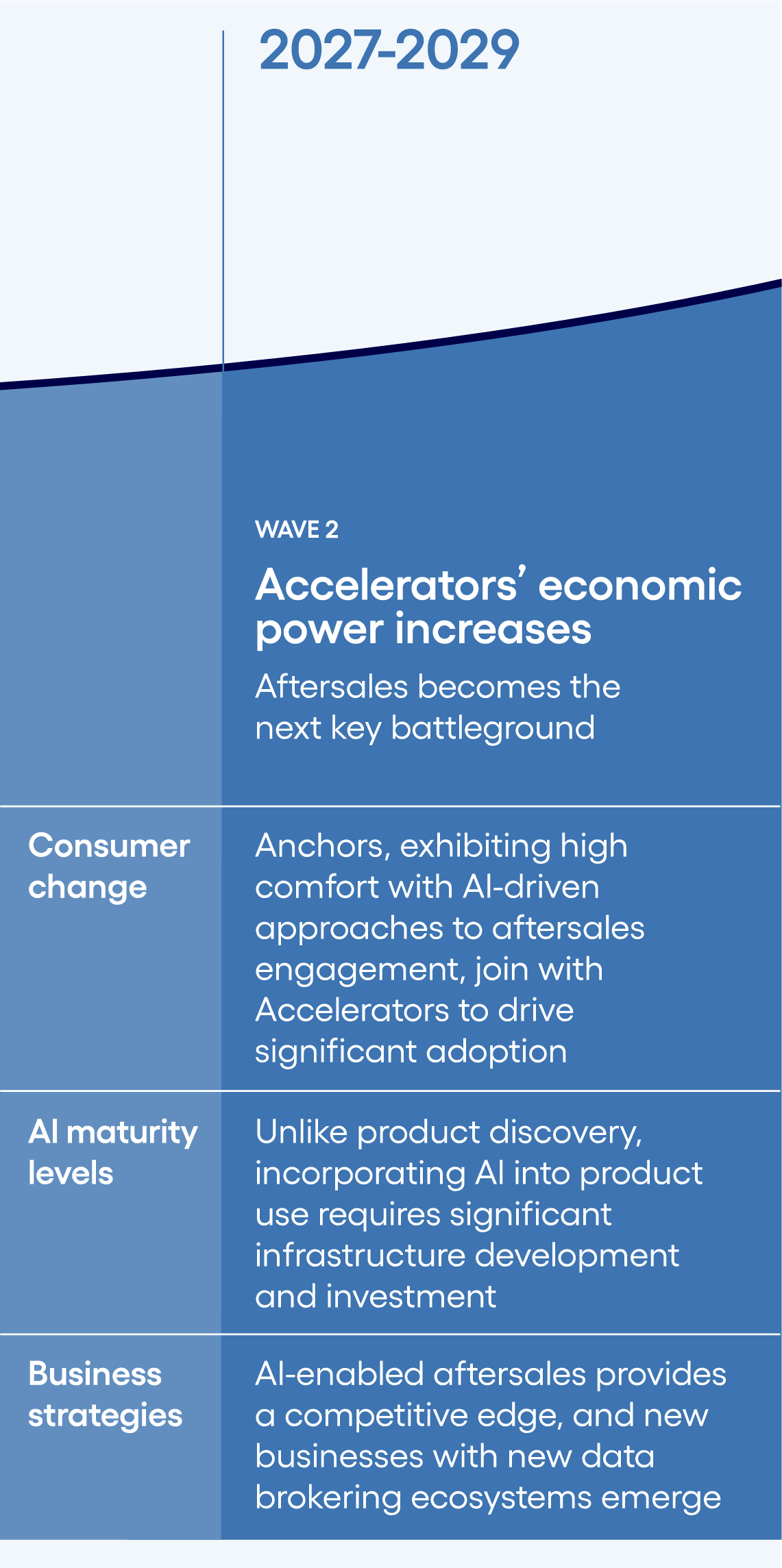
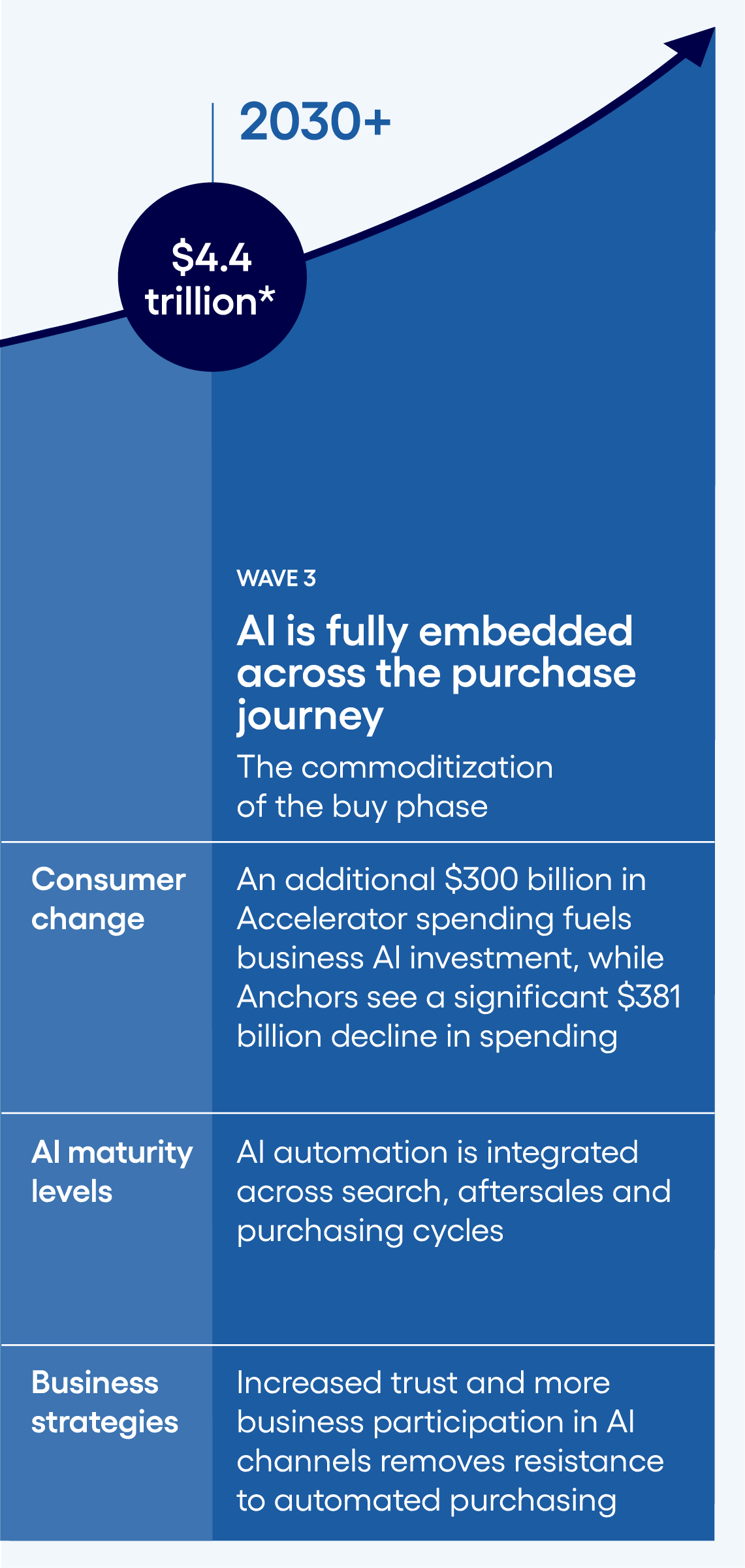
Based on these dynamics, we see dramatic market change ahead, characterized by three distinct periods of change between now and 2030. We’ve mapped out a timeline of how these changes will unfold, using our analysis of consumer groups, their AI adoption potential and their spending power, in addition to our own understanding of how AI ecosystems will develop and mature.
By 2030, AI will be fully embedded across all three phases of the purchasing journey.
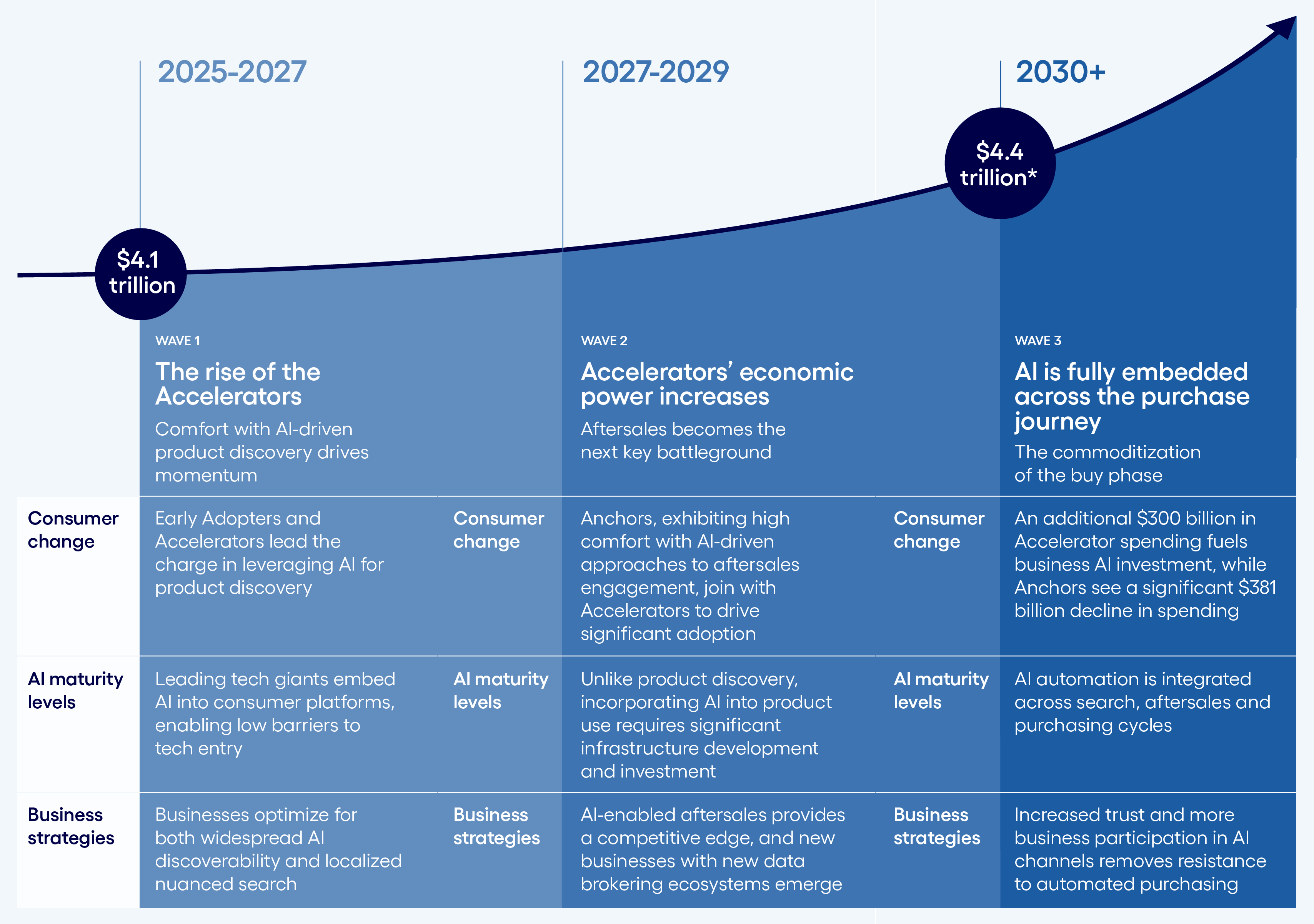
*Accelerators will see their consumption levels increase from $4.1T to over $4.4T in the US alone by 2030.
Figure 3
Source: Cognizant Research with economic data provided by Oxford Economics
*Accelerators will see their consumption levels increase from $4.1T to over $4.4T in the US alone by 2030.
Figure 3
Source: Cognizant Research with economic data provided by Oxford Economics
As these three waves unfold, consumer AI agents will proliferate, working with business AI agents to orchestrate complex tasks. Consumers will soon engage primarily with their AI agents rather than directly with the business itself.
To thrive in the AI-driven consumer era ahead, businesses will need to rethink how they operate across six important areas: strategy, technology, design, architecture, operations and ethics.
Leaders have less than five years to grapple with this change.
Capturing consumers’ attention in the Learn phase will require new rules of engagement. For instance, as AI-powered tools are increasingly used to research and discover products, businesses will have to take a multimodal approach to conveying their product and service information.
Once businesses have made themselves discoverable in the Learn phase, they should move onto the Use phase, where the consumer Comfort Quotient is also high. Using AI to engage with consumers after the sale will fortify the customer relationship.
Businesses can build on that trust in the Buy phase, where they can automate purchasing but with enough user control that it encourages confidence and loyalty.
As consumer AI agents become commonplace, businesses must have AI agents ready to interoperate with their consumer counterparts. This will require new infrastructure and data capabilities.
They should also consider partnering with leading AI providers to promote products and services and collaborate on features that ensure visibility. This level of integration requires APIs that connect with external AI platforms and exchange data with consumer AI agents. Simultaneously, infrastructure investments will be needed to handle the increased data demands of interacting with these agents and platforms.
By embedding their offerings into broader AI networks, companies can maintain visibility and relevance.
For consumers, the primary driver for using AI tools is convenience—not price.
This dynamic presents a significant opportunity for businesses to attract time-starved customers with a design-for-convenience mindset. AI-powered tools are already well suited to deliver convenience and speed through hyperspecialized recommendations, instant product comparisons and quick and reliable checkout processes. New agentic capabilities will only accelerate this.
By integrating AI functionalities and agents that simplify complexities within the purchasing journey, companies can capture consumers’ interest, regardless of their existing attitudes toward AI or prior experience with the brand.
Just as consumers have grown to trust mobile interfaces for high-stakes tasks, AI will gain acceptance as it becomes accessible through a variety of familiar and reliable devices, apps and platforms.
AI capabilities should be seamlessly integrated into a variety of channels in a way that feels natural to consumers, mirroring the versatility of mobile internet access.
As consumers become more accustomed to using AI in these trusted environments, their comfort with AI-powered decision-making in other areas of their lives will likely increase. Rather than feeling forced to use it in certain contexts, consumers would likely embrace AI applications that feel like a natural extension of the tools and devices they already use.
Even consumers who are comfortable using AI still value human interaction during critical moments, especially when it comes to high-stakes purchases like healthcare or financial services.
A set-it-and-forget-it AI strategy simply won't cut it. The winning approach is a hybrid one that blends AI and human interactions. For instance, design customer experiences that incorporate AI to efficiently gather product information and make initial inquiries. Then, ensure a smooth transition to human experts for complex questions, nuanced decision-making and a personal touch just when it’s needed.
By emphasizing human oversight in their AI implementations, businesses can create customer experiences that work for a wide range of consumers and situations.
One-third of people in the world still have no access to the internet. For these marginalized populations, the transition to the agentic internet may be a leap they’re unable to make.
To avoid widening the digital divide, businesses should offer alternatives to AI experiences at key stages of the purchase journey. For example, companies could integrate interactive AI tools into their brick-and-mortar locations.
By familiarizing these groups with AI-enabled technology throughout traditional purchasing channels, businesses can ensure equal opportunity of access for all consumers until a greater level of education and democratization occurs.
We’re entering a new era of commerce; it’s one marked by consumers delegating decision-making to AI-powered tools—an agentic approach to consumption. Business leaders will need to rethink their internal roadmaps to stay ahead of the adoption curve and be ready to anticipate the wants, needs and deal-breakers for a new class of AI-empowered customers.
Ollie O’Donoghue
Head of Cognizant Research


Duncan Roberts
Associate Director, Cognizant Research
Alexandria Quintana
Senior Manager, Cognizant Research
Ramona Balaratnam
Manager, Cognizant Research
Stella Maude
Analyst, Cognizant Research
Catrinel Bartolomeu
Head of Thought Leadership Editorial
Mary Brandel
Editor
Lynne LaCascia
Head of Brand, Thought Leadership